Jackets, monopiles and floating bodies in waves
FEA Offshore puts a structure in the sea: water depth, waves, current and soil. It steps design waves through jackets and monopiles, runs moored floating hulls in time, and checks tubular members and joints to the offshore codes.
From the sea state to the code check
Environment
Water depth, still-water level and design code. Regular design waves (Airy, Stokes 5th order, stream function), JONSWAP and Pierson–Moskowitz seas, current, marine growth and wind.
Fixed structures
Morison wave and current loads with buoyancy. Piles in clay and sand with API p-y, t-z and q-z springs, or PISA springs for monopiles. The Wave study steps the design wave through the structure.
Code checks
Tubular members and joints to API RP 2A-WSD, API RP 2A-LRFD, ISO 19902, NORSOK N-004, DNV-ST-0126 or KDS 64. Members are coloured by utilization and listed in a check table.
Floating and moorings
Rigid hulls with BEM hydrodynamics (.h5), chain, wire and polyester lines laid out on their catenary. Dynamic, RAO and Offset studies, and the mooring check to API RP 2SK or DNV-OS-E301.
Wind turbines
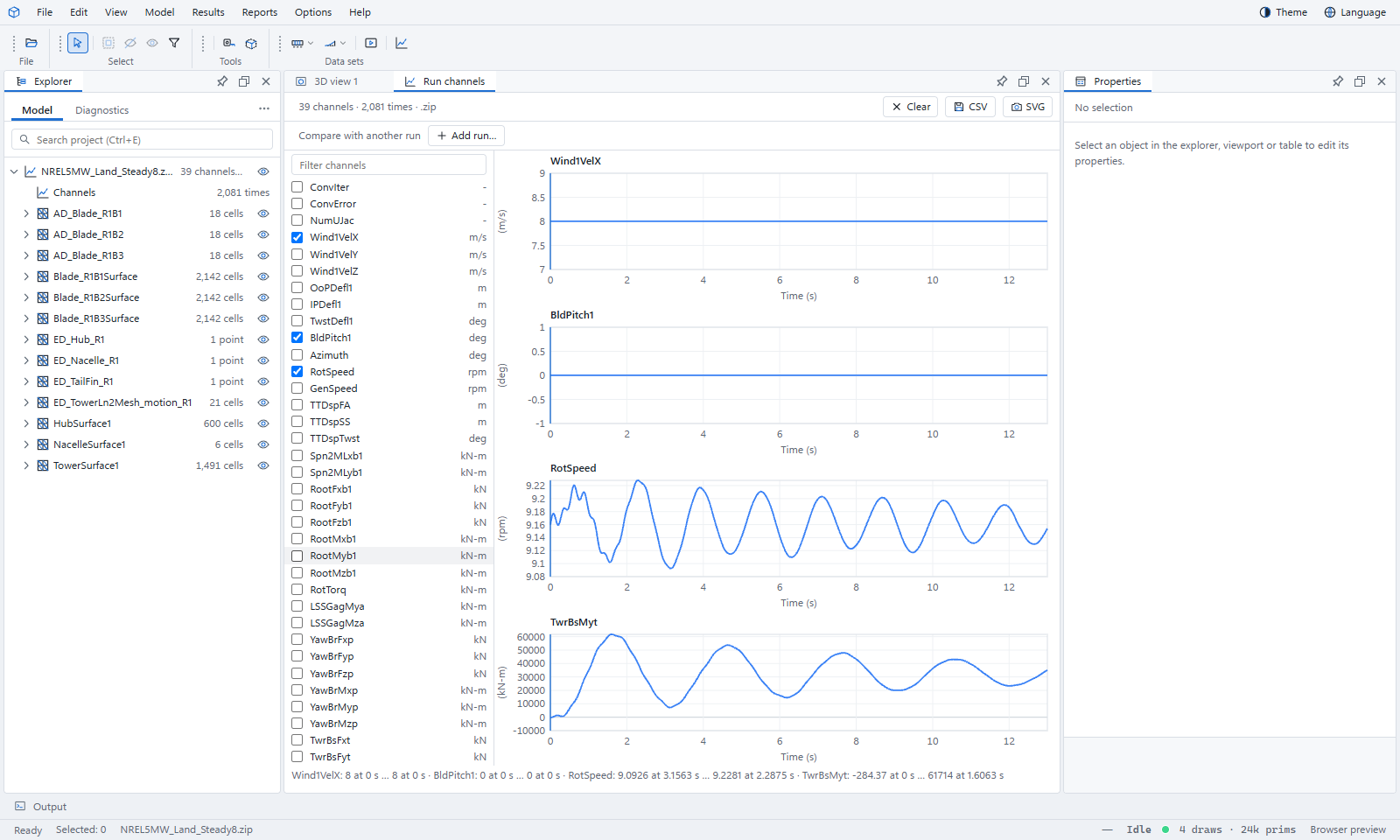
A rotor by thrust curve or two-way OpenFAST AeroDyn coupling. Save a floating model as an OpenFAST v5 deck or run it in OpenFAST. Hull hydrodynamics with NEMOH.
Beyond the storm
Fatigue (spectral, deterministic, time domain), seismic spectrum, pushover for reserve strength, ship impact and blast, installation checks, and wave energy power matrices.
One model, eight steps
The guided workflows (Offshore › Workflows) take you through the same steps for a jacket, a monopile and a floating body, with a button for each command.
Model
Members, sections and loads, from a sample or drawn.
Environment
Water depth, code, current, marine growth and sea states.
Foundation
Soil layers, piles, or mooring lines and a floating hull.
Mesh
Built from the model and rebuilt when it changes.
Analysis
Wave, Modal, Dynamic, RAO, Offset and more.
Results
Deflections, member forces, animation and charts.
Design
Member and joint checks, mooring check, fatigue.
Report
Model, environment, results and checks in one report.
Learn FEA Offshore step by step
Start with a sample, then build a jacket, a monopile and a moored hull with the guided workflows.
Run your first offshore sample
Open the four-leg jacket, run its Wave study, read the results and run the API code check.
Start →Fixed jacket platform
A four-leg jacket on piles in 60 m of water: storm wave, current, soil springs and API RP 2A-WSD checks.
Start →Offshore wind monopile
A 6 m monopile in 25 m of water: natural frequency against 1P and 3P, design wave, storm in time, ISO 19902.
Start →Moored floating body
A 5 m floating sphere on three catenary chains: BEM data, pretension, motions and line tensions in waves.
Start →Floating wind turbine with OpenFAST
The OC4 DeepCwind semi-submersible with the NREL 5 MW rotor coupled two-way, then a run in OpenFAST itself.
Start →Wave energy converter power
The RM3 two-body point absorber: PTO power in waves, RAOs and the power matrix with the annual energy.
Start →The FEA Offshore manual
One page covers the environment, loads, foundations, studies, code checks, floating bodies, OpenFAST and NEMOH.